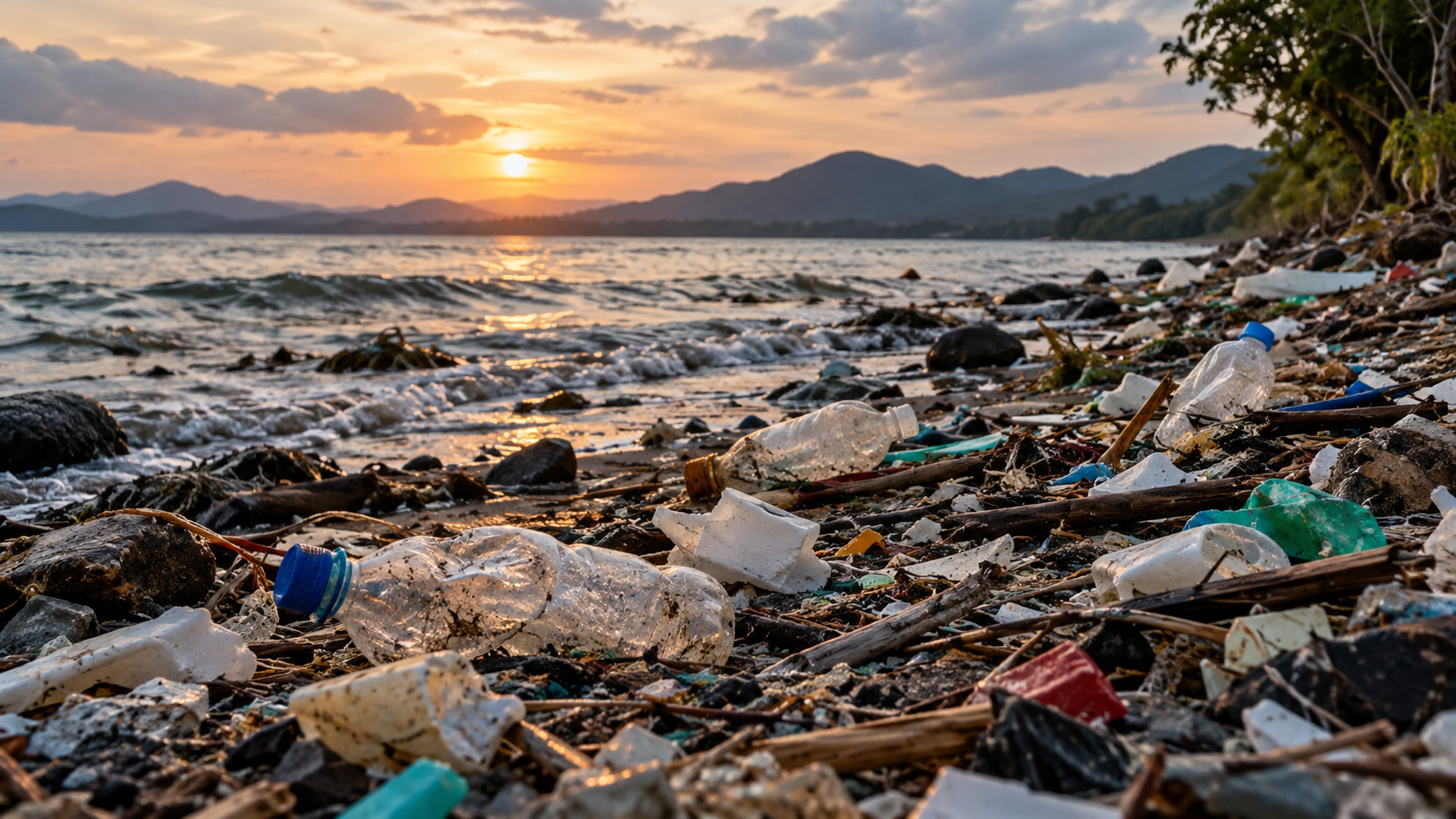
Take a plastic wrapper. You use it for a few minutes, drop it in a bin and stop thinking about it. From your point of view, the object has disappeared.
Physically, it has only changed location.
It might reach a controlled landfill. It might be collected for recycling. It might be burned. It might escape waste collection entirely and end up on a roadside, in a drain, in soil or in water. Sunlight, heat and abrasion can then break larger pieces into smaller fragments.
The global system is still mostly linear
The OECD estimated that the world generated about 353 million tonnes of plastic waste in 2019. After losses during recycling were counted, only about 9% was ultimately recycled. Roughly half went to sanitary landfills, 19% was incinerated, and 22% was mismanaged through uncontrolled dumping, open burning or environmental leakage.
That does not mean recycling is useless. It means recycling is one tool inside a much larger materials problem.
Many plastics are difficult or uneconomic to recycle because products can contain mixed polymers, dyes, adhesives, multilayer films, contamination and additives. Even material collected for recycling does not automatically become a new product.
Plastic can become smaller without becoming gone
When larger plastic objects fragment, they can form microplastics—commonly defined as plastic particles up to 5 millimetres in size. UNEP notes that these particles can originate as small particles or result from the breakdown of larger debris.
Smaller is not the same as harmless, and it is definitely not the same as disappeared. Fragmentation can make plastic harder to collect and easier to spread through water, soil and other parts of the environment.
Scientists are actively studying what different types and levels of microplastic exposure mean for ecosystems and human health. That research is still developing, so dramatic claims should be treated carefully. What is already clear is that plastic particles are now an environmental management problem at a scale much larger than a littered bottle.
Plastic pollution is also connected to climate change
Most conventional plastic begins with fossil-fuel feedstocks. Oil and gas are extracted, processed and converted into polymers before the finished product reaches a shelf. Energy is also used during manufacturing, transport and end-of-life treatment.
UNEP says plastic production is responsible for more than 3% of global greenhouse-gas emissions. OECD estimates for 2019 put the plastics lifecycle at about 3.4% of global greenhouse-gas emissions.
So a disposable plastic object has two environmental stories: what happens after it becomes waste, and the emissions associated with creating and managing it in the first place.
Why “just recycle it” is not enough
Recycling is valuable when a material can actually be collected, sorted and reprocessed into something useful. But a strategy that depends only on recycling asks the waste system to solve a problem that began much earlier—when the product was designed, manufactured and sold.
UNEP promotes a life-cycle approach: reduce unnecessary and short-lived plastic, expand reuse, improve product design and waste systems, and recycle where recycling genuinely works.
That changes the question from “Which bin should this go in?” to “Did this item need to become waste so quickly in the first place?”
The bin is not the end of the story
None of this requires pretending we can live without plastic tomorrow. Plastics are useful in medicine, transport, electronics, food systems and countless other applications. The problem is not that every piece of plastic is automatically bad.
The problem is designing a huge flow of durable material for extremely short use, then acting surprised when waste systems cannot make it vanish.
The next time you throw away a plastic packet, imagine its journey continuing after the lid closes. Maybe it is managed properly. Maybe it becomes feedstock for another product. Maybe it is buried. Maybe it escapes.
The important part is remembering that “away” is a direction, not a destination.