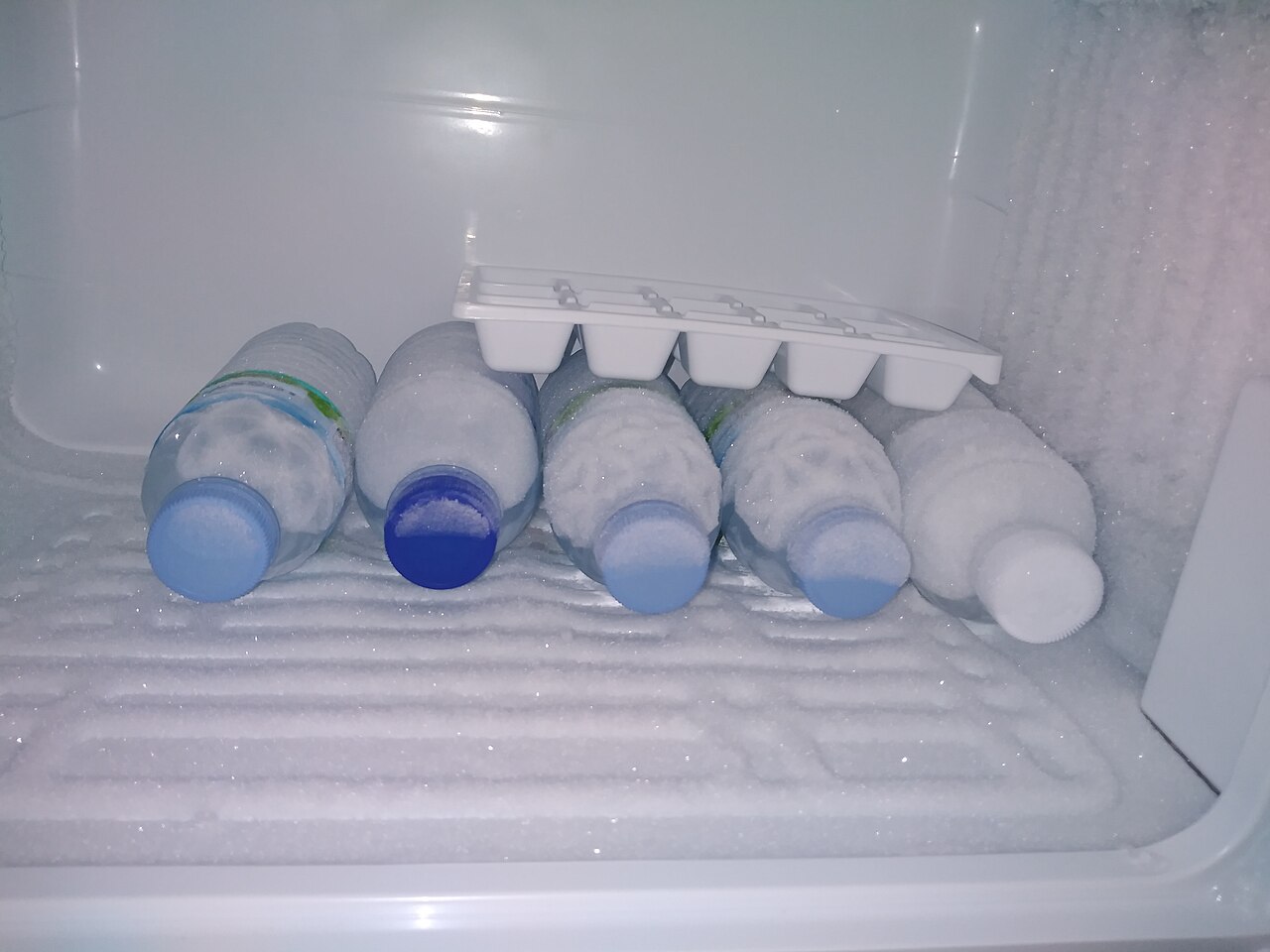
There is a boring little mystery hiding behind almost every freezer door. Make a tray of ice, ignore it for a few weeks, then look closely. The cubes may no longer fill their compartments the way they did. Edges retreat. Surfaces turn rough. Old cubes can look as if someone has quietly taken a bite out of them.
The freezer is below the melting point, so where did the missing water go?
The ice did not melt. It left as vapor.
Water can move directly from solid ice into water vapor without becoming liquid first. That process is called sublimation. The U.S. Geological Survey describes the same phenomenon when snow and ice disappear into dry air without melting, and University of Wisconsin Extension points out that ordinary ice cubes can visibly shrink in a freezer for the same reason.
At the surface of an ice cube, water molecules are constantly jostling. Some gain enough energy to escape into the surrounding air. If the air around the cube is dry enough, more molecules leave than return. The cube loses mass molecule by molecule.
It is painfully slow compared with melting. That is why you can watch an ice cube melt but you normally only notice sublimation after days or weeks. The result is still weird: the freezer is effectively drying the ice while keeping it frozen.
Your freezer is a very cold desert
Cold air cannot hold much water vapor. Freezers also circulate air and repeatedly remove moisture as frost or condensate in different parts of the system. To an exposed ice cube, that creates conditions where surface moisture can keep escaping.
This does not mean your freezer is literally vacuum freeze-drying everything inside it. Commercial freeze-drying is much more aggressive: frozen food is placed under controlled low pressure so ice can be removed rapidly as vapor. But the basic phase change—ice becoming vapor—is the same family of physics.
This is also part of the story behind freezer burn
Now replace the ice cube with a piece of frozen food. Frozen food contains plenty of water locked into ice crystals. When moisture leaves exposed areas, the surface dries out. USDA food-safety guidance describes freezer burn as a quality problem caused when air reaches the food surface and dries it out.
Iowa State University Extension explains the microscopic version directly: ice crystals at the food surface can move into vapor, leaving the outer layers dehydrated. That can produce the dry, pale, leathery patches we call freezer burn.
The important distinction is safety versus quality. USDA says freezer burn itself does not make food unsafe; it mainly makes parts of the food dry and unpleasant. Safe handling and storage temperature still matter separately.
The useful part: air is the enemy
This strange physics gives you a practical rule for frozen food: reduce contact with air. USDA recommends tight, freezer-appropriate wrapping and notes that ordinary supermarket wrapping can let enough air through for quality to decline during longer storage.
For home use, that means pushing excess air out of freezer bags, wrapping food closely instead of leaving large air pockets, using containers that fit the portion, and keeping packages sealed after opening. The goal is not to stop molecular motion completely—you cannot—but to slow moisture loss enough that the food stays better for longer.
This is also why loose bread, half-open ice-cream tubs and unwrapped leftovers can become dry, crusty or oddly textured while still completely frozen.
Why old ice tastes “freezery”
Shrinking is not the only reason ancient ice cubes become unappealing. Ice and frost can also pick up odors from the freezer environment, especially when food is poorly sealed. The longer cubes sit exposed, the more opportunity there is for surface changes and odor transfer.
If your ice smells strange, the useful fix is not to wash the cubes. Dump the old batch, clean the tray or bin, and check for uncovered or strongly scented food nearby. Fresh ice stored cleanly and used regularly will usually taste better.
The same trick happens outside your kitchen
Sublimation is not a freezer-only curiosity. USGS notes that snow can disappear directly into vapor under cold, dry conditions. In dry mountain air, a snowpack can lose water without first producing a stream of meltwater.
So the vanishing ice cube is a tiny household version of a process that also changes snowfields, preserves freeze-dried foods and slowly dries frozen leftovers.
A freezer is not a pause button
We tend to imagine frozen things as chemically and physically suspended. They are not. Freezing slows many processes dramatically, but it does not make matter motionless. Molecules still move. Water can migrate. Air can dry surfaces. Food quality can change while the food remains hard as a rock.
That is the useful weirdness: a freezer keeps food cold, but it does not make time stop.
Next time you find a shrunken ice cube, do not blame a leak in the tray. You may be looking at water that escaped without ever becoming a puddle.