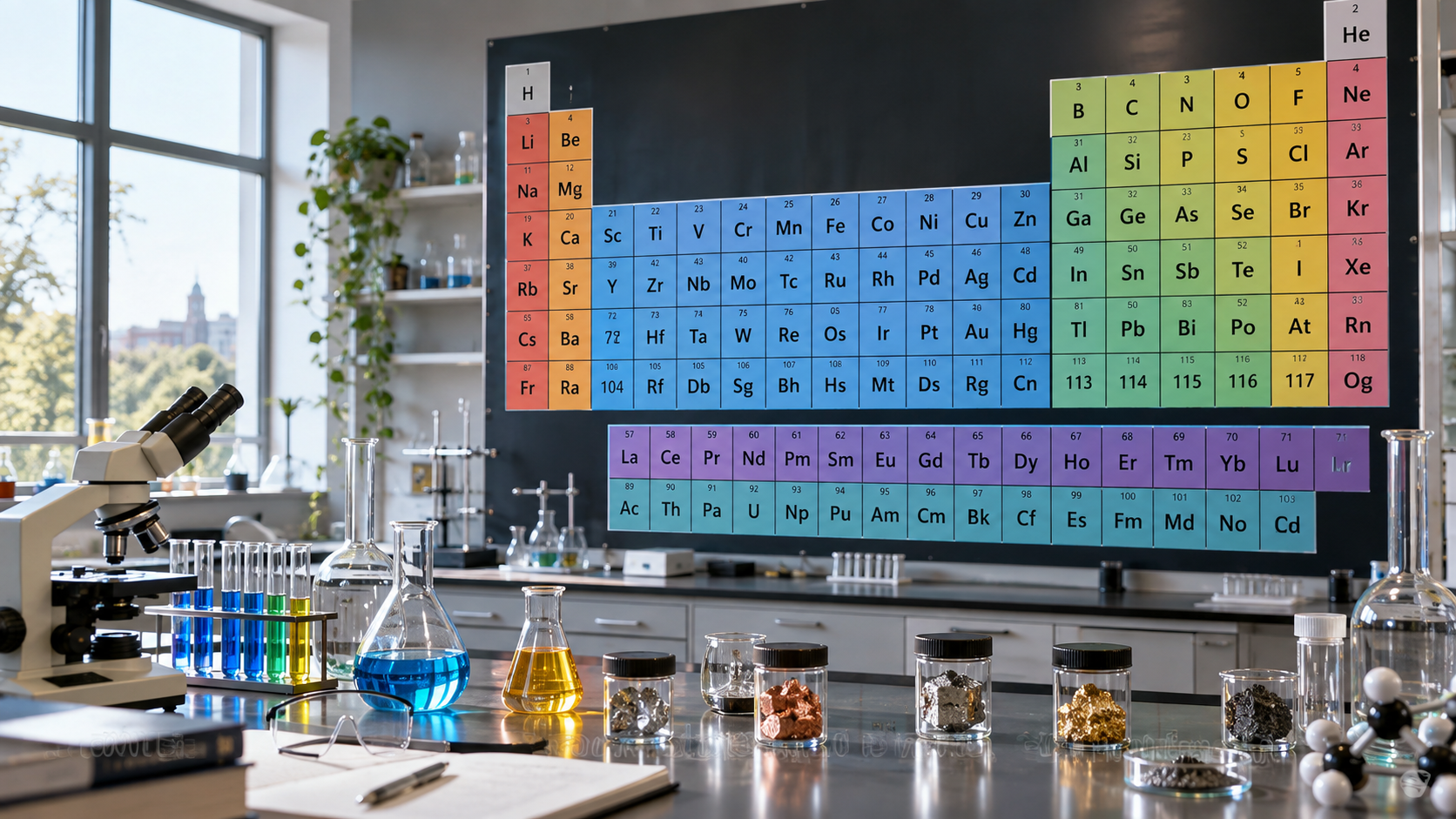
Start with the number in every box
Each element is defined by its atomic number: the number of protons in the nucleus. Hydrogen has 1 proton, helium has 2, lithium has 3, and so on. The modern periodic table is arranged in increasing atomic number from left to right.
That sounds almost too simple, but it fixes the identity of the element. Change the number of neutrons and you get a different isotope. Change the number of electrons and you get an ion. Change the number of protons and you have changed the element itself.
Why the table has rows
The horizontal rows are called periods. There are seven periods. As you move across a period, atomic number rises one step at a time and electrons are added to the atom’s available energy levels and subshells.
A new row begins when the next electron pattern starts filling a new principal energy level. That is why the first row has only hydrogen and helium, while later rows become much wider.
The strange shape of the table is therefore a consequence of quantum structure, not graphic design. The boxes stretch because electrons do not all occupy identical states; they fill families of orbitals with different capacities.
Why the columns matter even more
The vertical columns are called groups, numbered 1 through 18. Elements in the same group often have similar chemistry because they share related outer-electron arrangements.
For the main-group elements, this is especially easy to see. Lithium, sodium and potassium sit in Group 1 and each has one electron in its outermost shell. Fluorine and chlorine sit in Group 17 and are one electron short of a filled outer shell. Neon and argon sit in Group 18 with especially stable outer-electron arrangements.
This does not mean every element in a group behaves identically. Atomic size, shielding, nuclear charge and other effects change as you go down. But the family resemblance is strong enough that chemists can use position to make predictions.
The left side, right side and middle tell different stories
Most of the elements on the left and in the centre are metals. They tend to conduct electricity, form positive ions and share metallic properties. The upper-right region contains most of the nonmetals, including oxygen, nitrogen and the halogens. Along the rough boundary between them sit elements often called metalloids, which show mixtures of metallic and nonmetallic behaviour.
The large central block — Groups 3 through 12 — contains the transition metals. Their electron structures make their chemistry more complicated than the simplest “outer electrons equal group number” rule, but their placement still follows the same underlying electron-filling logic.
What are the s, p, d and f blocks?
The table can also be divided into four blocks: s, p, d and f. These names refer to the type of electron subshell being filled as atomic number increases.
The two columns on the left mostly form the s-block. The six columns on the right form the p-block. The ten-column transition-metal region is the d-block. The two detached rows usually printed underneath are the f-block.
Those bottom rows — the lanthanides and actinides — are not really separate from the table. They belong inside periods 6 and 7. They are pulled out mainly so the table can fit on a normal page without becoming absurdly wide.
The table contains directions
One of the most useful things about the periodic table is that properties tend to change in recognizable directions.
Atomic radius generally gets smaller from left to right across a period because the nucleus gains protons and pulls the electron cloud inward more strongly. It generally gets larger as you move down a group because additional electron shells are added.
First ionisation energy — the energy needed to remove an electron — generally rises across a period and falls down a group. Electronegativity, a measure of how strongly an atom attracts electrons in a bond, shows a broadly similar left-to-right increase and top-to-bottom decrease.
These are trends, not perfectly smooth laws. Electron subshells create important exceptions. But the trends are strong enough to explain why fluorine is extremely electronegative, why alkali metals readily lose electrons and why atomic sizes differ across the table.
Why Group 1 metals become so reactive
Take lithium, sodium and potassium. All three have one outer electron. Losing that electron gives them a more stable electron arrangement, so they commonly form +1 ions.
As you move down the group, that outer electron is farther from the nucleus and more shielded by inner electrons. It becomes easier to remove. That helps explain why the Group 1 metals become more reactive down the group.
The table is doing more than placing similar elements together. It is showing a direction in which a property changes.
Why the noble gases sit at the far right
Group 18 contains the noble gases: helium, neon, argon and their heavier relatives. Their outer electron arrangements are unusually stable, so they are generally much less reactive than neighbouring elements.
Helium is an interesting special case. It has only two electrons, not the eight often associated with a “full outer shell,” but its first and only shell is complete. That is why its chemistry fits the noble-gas family even though its electron configuration looks different from neon or argon.
Why Mendeleev’s old table was such a big deal
Dmitri Mendeleev did not know about protons or modern electron structure. In the 19th century, he arranged known elements largely by relative atomic mass while paying close attention to repeating chemical properties.
The remarkable part was that he left gaps. Instead of forcing every known element into a bad pattern, he treated missing spaces as evidence that undiscovered elements should exist and predicted some of their properties.
Later, atomic number became the correct organizing principle for the modern table. The deeper reason for the repeating pattern was eventually understood through atomic and quantum structure.
How to use the table instead of memorizing it
When you look at an unfamiliar element, start with four questions: What is its atomic number? Which group is it in? Which period is it in? Which block is it in?
From there you can make useful first guesses. Is it likely to be metallic or nonmetallic? Does its group contain highly reactive elements, noble gases or transition metals? Is the atom likely to be larger or smaller than a nearby element? Is removing an electron likely to become easier or harder as you move across the row?
You still need real data for exact melting points, densities, oxidation states and exceptions. But the table gives you a framework before you know any of those numbers.
The periodic table is a prediction machine
The magic of the periodic table is not that it stores 118 names. A simple alphabetical list could do that.
Its value is that position carries information. Atomic number controls the order. Electron structure creates rows and blocks. Similar outer-electron patterns create chemical families. Those structures produce trends that let chemists compare elements and predict behaviour.
Once you see that, the periodic table stops looking like a chart you were forced to memorize at school. It becomes what it really is: one of science’s most compact maps of how matter is organized.