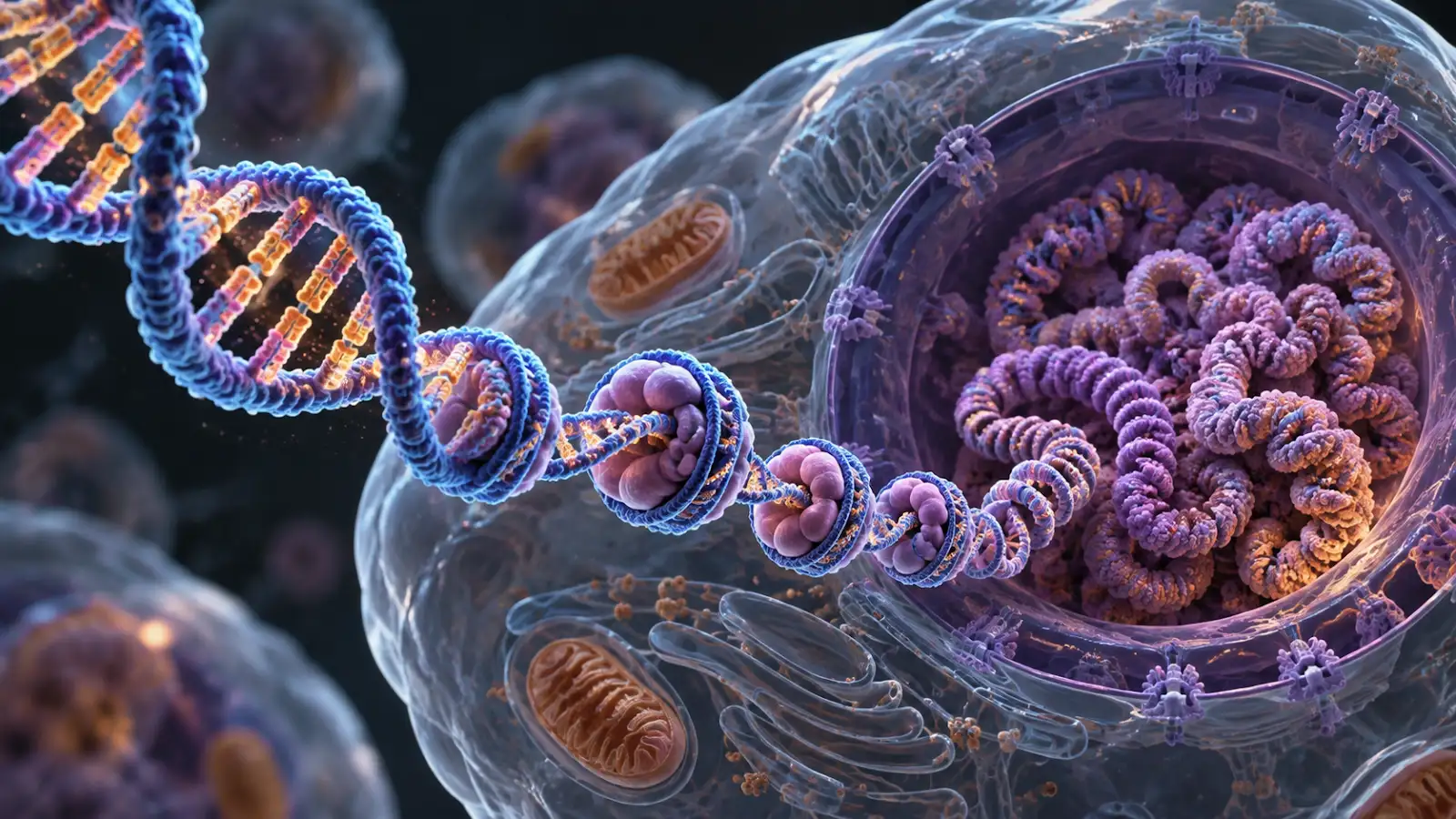
First: where does the “two metres” number come from?
A typical human body cell carries two copies of most chromosomes, one set inherited from each parent. Together those chromosomes contain roughly six billion DNA base pairs. The distance along DNA is about 0.34 nanometres per base pair, so if the molecule were fully extended, the total length works out to around two metres.
The National Human Genome Research Institute describes the same scale another way: the DNA in one human cell, unwound from its proteins and placed end to end, would stretch about six feet. That is an astonishing mismatch of scale between the genetic material and the compartment that holds it.
DNA does not float naked in the nucleus
The first big idea is that DNA in human cells is almost never a bare molecule. It is associated with proteins, especially a family called histones. DNA carries a negatively charged backbone, while histones contain positively charged regions, helping the two associate closely.
Histones provide structural support and help package the genome. Eight histone proteins form a core around which DNA winds. This DNA-plus-protein unit is called a nucleosome.
Nucleosomes are molecular spools
A nucleosome contains roughly 150 base pairs of DNA wrapped around a histone core. Under an electron microscope, extended chromatin can resemble “beads on a string”: the beads are nucleosomes and the connecting thread is DNA between them.
Wrapping DNA around millions of these tiny protein spools immediately shortens the effective length of the molecule. But that is only the beginning. Nucleosomes themselves are arranged into larger structures, and those structures form loops and domains throughout the nucleus.
The packaging is not a simple set of Russian dolls
Older textbook drawings often show a neat ladder of packing: DNA helix → nucleosome → thicker fibre → larger coils → chromosome. That picture is useful for learning, but real chromatin inside living cells is more dynamic and irregular.
The genome folds in three dimensions. Distant stretches of DNA can be brought physically near one another, while neighbouring stretches on the DNA sequence can occupy different local environments. This matters because genes are controlled not only by the letters in DNA but also by which regions are physically accessible to the cell’s molecular machinery.
Packing DNA creates a second problem: access
Compressing the genome is only useful if the cell can still reach the right information. A skin cell, a neuron and a liver cell contain essentially the same genome, yet they use different sets of genes. One reason is that chromatin can be made more open or more compact in different places.
When a gene needs to be read, proteins can remodel nearby chromatin, shift or temporarily remove nucleosomes, and make that DNA more accessible. Histones can also carry chemical modifications associated with different chromatin states. Packaging is therefore not just storage — it is part of gene regulation.
Why doesn’t all that DNA become hopelessly tangled?
Long polymers naturally face knotting and tangling problems, and DNA is no exception. Cells use specialized enzymes and structural proteins to manage DNA topology, organize loops and prevent the genome from becoming an unusable mess.
For example, enzymes called topoisomerases can temporarily cut DNA, allow strands to pass or rotate, and then reseal them. Other protein complexes help organize chromosomes into loops and territories. The result is not perfect stillness but controlled movement: DNA is constantly being copied, repaired, read and reorganized.
Chromosomes are not always the X shapes from school diagrams
The familiar X-shaped chromosome is most obvious during cell division, when duplicated chromosomes become highly condensed so they can be separated cleanly into two daughter cells.
For most of a cell’s life, chromosomes are less condensed and occupy regions of the nucleus as chromatin. This looser organization allows enzymes to reach DNA for transcription, replication and repair. So a chromosome is not usually sitting inside the nucleus as a rigid X.
The nucleus is organized space, not a bag of spaghetti
Modern genomics has shown that chromosomes tend to occupy preferred territories and that the genome forms loops and contacts in three dimensions. These contacts can place regulatory DNA near genes it helps control, even when the two regions are far apart along the chromosome.
This is one reason genome researchers care about 3D folding. A mutation can matter not only because it changes a protein-coding sequence, but sometimes because it disrupts a regulatory element or the spatial relationship between pieces of DNA.
Does every human cell contain two metres of nuclear DNA?
No. “About two metres per cell” is a useful statement for a typical diploid human cell, but biology has exceptions. Mature red blood cells lose their nuclei and therefore do not carry the usual nuclear genome. Sperm and egg cells carry one set of chromosomes rather than two. Some cell types can have unusual chromosome copy numbers, and cells also contain a small amount of separate mitochondrial DNA.
So the striking two-metre comparison should be understood as an approximate scale, not a rule that literally applies to every cell in the body.
If everyone has DNA, why is each person different?
Human DNA is mostly alike because we are all members of the same species and need the same basic biological instructions: how to build cells, organs, blood, nerves, muscles and the rest of the human body. That is why most of the DNA sequence is shared from one person to another.
But “mostly the same” does not mean identical. Across billions of DNA letters, each person carries many small variations inherited from their parents, mixed into a new combination during reproduction. New mutations can also appear. Those differences can influence traits such as appearance, metabolism and disease risk.
Even DNA sequence is only part of the story. Which genes are switched on, when they are used, development, environment and life experience all affect how a person turns out. So humans are built from an overwhelmingly shared genetic blueprint, but every individual carries a slightly different edition of it.
Why this packing system matters to health
The way DNA is folded and made accessible influences which genes a cell uses. Problems involving chromatin-remodelling proteins, histones, DNA repair or chromosome organization can contribute to disease. Cancer researchers, developmental biologists and geneticists therefore study not just DNA sequence but the physical and chemical state of chromatin.
Two people can talk about “the genome” and mean slightly different layers: the DNA sequence itself, the proteins bound to it, chemical marks associated with it, or its three-dimensional organization. Modern biology increasingly treats all of those layers as connected.
The remarkable part is not that DNA fits — it is that it still works
Fitting two metres of DNA into a microscopic nucleus is impressive. But storage is only half the achievement. The cell must also find a gene, open the right region, copy DNA before division, repair breaks, regulate activity and then repack everything without losing the overall organization.
DNA succeeds because it is not packed like rubbish crushed into a bin. It is packaged like an active information system. Histones create nucleosomes; nucleosomes build chromatin; chromatin folds into a changing 3D architecture; and molecular machines continuously reorganize that architecture as the cell works.