TECHNOLOGY & SCIENCE · OCTOBER 11, 2026 · 8 MIN READ
How Does a Computer Understand Only 0 and 1?
From microscopic transistors to pictures, music and AI: discover how two electrical states power the digital world.
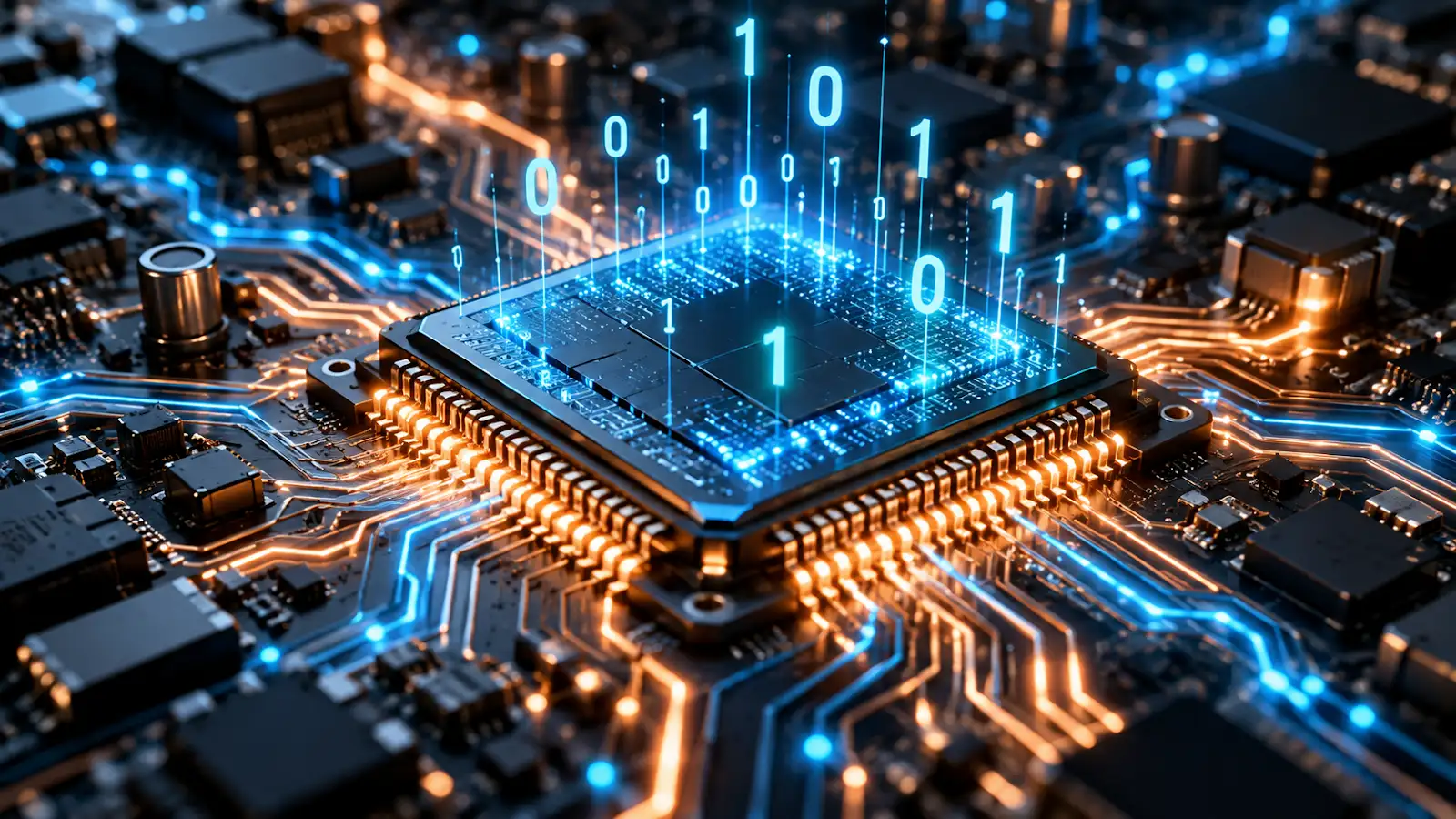
Does a computer really understand 0 and 1?
Not in the way humans understand words or numbers. Inside a computer, electronic circuits react to voltages. Engineers assign two distinguishable states the labels 0 and 1. These states are called bits, the smallest units of digital information.
The tiny switch behind everything
A transistor is an electronic component that can control electrical current. Modern processors contain billions of them. Connected into circuits, transistors behave like switches and help produce reliable high and low logic states. Real transistors are not perfect switches, but digital circuits are designed to tolerate small electrical variations.
How binary counting works
Our everyday decimal system uses ten digits, 0 through 9. Binary uses just two. Each place represents a power of two. For example, 1011 in binary means 8 + 0 + 2 + 1, which equals 11. Eight bits form a byte.
How can switches calculate?
Transistors are combined into logic gates. An AND gate outputs 1 only when both inputs are 1; an OR gate outputs 1 if at least one input is 1; and a NOT gate reverses its input. Networks of gates form circuits that add numbers, compare values and make decisions. In binary, 1 + 1 = 10, meaning zero in the current column and a carry into the next.
How do bits become letters?
Software uses character encodings to associate numbers with written symbols. For example, the capital letter A has Unicode code point U+0041, represented in UTF-8 by the byte 01000001. Many other scripts, including Tamil, use multiple bytes for some characters. The bits alone do not say what they mean; an agreed encoding provides the interpretation.
How do bits become photos and sound?
Digital photographs store numerical values for pixels, often describing red, green and blue color components. Digital audio stores measurements of a sound wave taken repeatedly over time. The screen and speakers convert these numbers back into light and sound.
How does a CPU follow a program?
Programs eventually become machine instructions represented by bit patterns. The processor fetches instructions from memory, decodes them and executes operations using its circuits. Compilers, interpreters and operating systems connect human-written programs to this hardware.
Why just two states?
It is easier to reliably distinguish two voltage ranges than many narrowly separated levels, especially in the presence of noise. Computers still rely on analog physics, precise timing and complex materials; binary is the convenient abstraction that makes digital systems practical.
Try it yourself
Decode 1101. From right to left the place values are 1, 2, 4 and 8. Add the positions containing a 1: 8 + 4 + 1 = 13. You have just read binary like a computer engineer.
The big idea
A computer is not a box that magically understands numbers. It is an enormous collection of carefully arranged physical circuits. Software gives meaning to the patterns, turning two dependable electrical states into messages, games, videos and the modern internet.
Sources and further reading
Computer History Museum · The Unicode Standard · Nand2Tetris