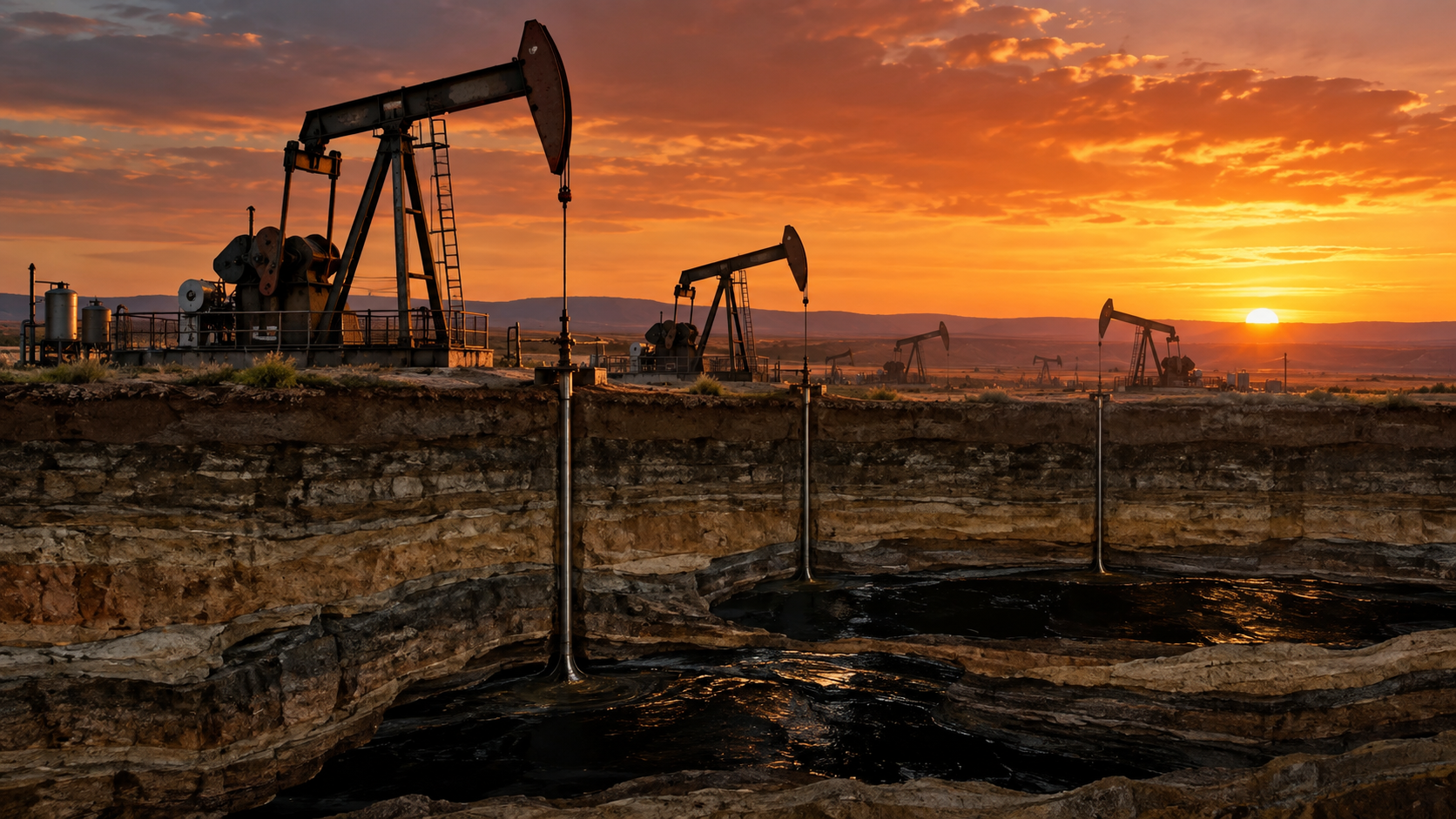
First: there is no literal countdown to “zero oil”
At the end of 2024, OPEC reported about 1.567 trillion barrels of proved crude-oil reserves worldwide. At roughly 100 million barrels of oil demand per day, simple division gives a few decades of supply. But that arithmetic is misleading.
“Proved reserves” are not all the oil that exists underground. They are deposits judged commercially recoverable under current economics, technology and knowledge. New discoveries, higher prices and better extraction methods can move oil from “resource” to “reserve,” while fields can also become uneconomic and move the other way. The U.S. Energy Information Administration specifically warns against treating the reserves-to-production ratio as a clock counting down to the day oil disappears.
So the useful thought experiment is this: what if humanity tried to extract and use nearly all of the oil that is commercially recoverable instead of replacing most of it?
The number that changes the story: about 670 billion tonnes of CO₂
The U.S. EPA estimates that burning one barrel of crude oil ultimately releases about 0.43 metric tonnes of CO₂. Multiply that by 1.567 trillion barrels of currently proved crude reserves and you get roughly 674 billion tonnes of CO₂ from combustion alone.
That is not a prediction: not every reserve will necessarily be produced, some oil becomes long-lived materials rather than fuel, reserves change over time, and extraction and refining add emissions of their own. But it gives a sense of scale.
Would Earth “end”?
No. The planet itself would survive. Life would survive. Humans would survive. The scientifically credible danger is not a movie-style ending of Earth; it is a progressively harsher planet for civilisation.
The IPCC finds that climate risks rise with every increment of warming. Higher warming increases the likelihood and severity of extreme heat, drought, heavy rainfall, wildfire conditions, coastal flooding, ecosystem loss and pressure on food and water systems. Those changes do not happen everywhere equally, and adaptation can reduce many risks, but the burden grows as warming rises.
A hotter world would not just mean hotter afternoons
Heat changes how cities, farms, rivers and bodies work. WHO says climate change is already increasing exposure to extreme heat, and heat stress can worsen cardiovascular, kidney, respiratory and other illnesses. More warming raises the number of days when outdoor work becomes dangerous, electricity demand for cooling surges and power systems are stressed exactly when people need them most.
For agriculture, the problem is not simply “plants like warmth.” Crops depend on temperature windows, water, soil moisture, pollinators and stable seasons. The IPCC concludes that food-security risks rise with warming, especially in already-hot regions. Droughts, floods and heatwaves can also strike multiple food-producing regions at the same time, making shortages and price spikes harder to absorb.
The ocean would take part of the carbon — and pay for it
Oceans absorb a large share of the carbon dioxide humans emit. That slows the rise of CO₂ in the atmosphere, but it changes seawater chemistry. NOAA explains that dissolved CO₂ increases ocean acidity and reduces carbonate ions used by corals, shellfish and other organisms to build hard structures.
So using the ocean as a giant carbon sink is not a free service. More fossil carbon means more ocean warming, more acidification and greater pressure on coral reefs and marine food webs.
The coastline problem lasts much longer than the oil era
One of the strangest facts about climate change is that the consequences can outlive the cause. The IPCC says sea level is committed to rise for centuries to millennia because the deep ocean warms slowly and ice sheets respond slowly.
Under a very high greenhouse-gas emissions pathway, the IPCC's likely global sea-level rise by 2100 is about 0.63 to 1.01 metres relative to 1995–2014. That does not mean every coast rises by the same amount, and the exact future depends on emissions and ice-sheet behaviour. But higher emissions lock in greater and faster long-term rise.
For coastal cities, the first problem is often not a city disappearing under water. It is that today's rare high-water events become common: storm surges reach farther inland, drainage fails more often, saltwater enters groundwater and defending infrastructure gets more expensive.
Before we reach the last barrel, extraction itself would probably get harder
The easiest oil fields are attractive because they produce large amounts of oil with relatively little effort. As mature fields decline, maintaining supply can require new wells, deeper water, tighter rock, enhanced recovery or development in more difficult environments.
That does not guarantee that every future barrel has a higher environmental impact; technology can improve efficiency and safety. But a strategy of “keep producing whatever it takes” creates pressure to develop deposits that earlier generations considered too difficult, risky or expensive.
And then there is methane
Oil fields often produce natural gas alongside crude. Methane can escape through equipment, tanks and other parts of the production system. UNEP notes that methane is responsible for roughly a third of current warming and is far more powerful than CO₂ over the first decades after release, although it remains in the atmosphere for much less time.
That means an all-out oil-extraction future would not be only a CO₂ story. The climate result would also depend on how well methane leaks, venting and flaring were controlled.
What happens to society as oil becomes scarce?
Probably not a clean moment where the final petrol station closes. Scarcity tends to appear economically first. The cheapest supply disappears, prices become more sensitive to disruption, and countries that import most of their oil become more exposed to shocks.
Transport would feel it strongly because road vehicles, aviation and shipping still rely heavily on petroleum fuels. Petrochemicals would matter too: oil is a feedstock for plastics, synthetic fibres, solvents, lubricants and many industrial products.
A world that waited until oil was genuinely scarce before building replacements would face a painful race: replace cars, trucks, heating systems, aircraft fuels, industrial feedstocks and infrastructure while energy prices were already under pressure.
The alternative is not one magic replacement for oil
Oil does several jobs, so replacing it requires several technologies. For electricity, the alternatives are already mature: solar, wind, hydropower, nuclear power and other low-carbon sources. IRENA reports that more than 90% of utility-scale renewable projects commissioned in 2025 produced power below the cost of the cheapest new fossil-fuel plant in their market.
For cars, buses and a growing share of trucks, the strongest substitute is direct electrification. The IEA estimates that electric vehicles displaced around 1.7 million barrels of oil per day in 2025 and could displace around 5 million barrels per day by 2030 under current-policy pathways.
Public transport, rail, walking, cycling, better city design and more efficient vehicles matter too because the cheapest barrel to replace is the one nobody needs to burn.
What about planes, ships and heavy industry?
Those are harder. Batteries are excellent for many road vehicles but much more difficult for long-haul aircraft and some shipping because energy density matters. Likely solutions include a mix of efficiency, sustainable aviation fuels, advanced biofuels, hydrogen-derived fuels, ammonia or methanol for some ships, and eventually synthetic fuels made with low-carbon electricity.
None is a perfect drop-in answer today. Some require huge amounts of clean electricity, some are expensive, and biofuels can compete for land or feedstocks if scaled carelessly. The realistic future is a portfolio, not a miracle fuel.
And plastic? Oil is not only burned
Even in a deeply electrified world, society may still need carbon-based molecules for chemicals and materials. That makes circular design more important: use less material, reuse products, recycle where it actually works, design polymers for recovery, and substitute recycled, bio-based or captured-carbon feedstocks where they make environmental and economic sense.
The IEA expects petrochemicals and aviation to be among the more persistent sources of oil demand even as road transport electrifies. That is another reason “replace every barrel with electricity” is too simple.
The future does not require waiting for the last barrel
There is a much less dramatic path. Oil can become less important because better technologies replace its services before geology forces the change. That is already beginning: electric vehicles are reducing petrol and diesel demand, renewable power is expanding rapidly, and many economies are using more electricity for transport, buildings and industry.
The IPCC's low-warming pathways do not assume that every fossil fuel molecule disappears immediately. They do require fossil-fuel use to fall substantially, with the remaining uses increasingly limited, substituted or paired with measures that prevent emissions from reaching the atmosphere.
So what would the “end of oil” really look like?
Probably nothing like the last scene of a disaster film. There may never be a ceremonial final barrel. Long before that, some fields become uneconomic, some countries reduce demand, some uses electrify, and the remaining oil becomes concentrated in sectors that are harder to replace.
The dangerous version of the future is one where humanity insists on extracting and burning nearly everything it can. Earth would still turn. People would still build cities and grow food. But we would be doing it with more heat, higher seas, more stressed ecosystems, greater pressure on water and food, and a larger adaptation bill handed to generations that did not burn the oil themselves.
The better ending is less cinematic: the final barrel is never needed.
Not because we suddenly discovered an infinite new fuel — but because electricity, efficiency, storage, cleaner fuels and smarter use became better ways to do the jobs oil once did.
Sources & further reading
- OPEC Annual Statistical Bulletin 2025 — world proved crude-oil reserves
- U.S. EIA — why reserves are not a simple countdown to “running out”
- U.S. EPA — about 0.43 metric tonnes of CO₂ per barrel of crude oil consumed
- Global Carbon Budget 2025 — remaining carbon budgets from January 2026
- IPCC AR6 Synthesis Report — warming, sea level and long-term climate risks
- IPCC WGII — food, water, ecosystems and risks at increasing warming levels
- NOAA Fisheries — ocean acidification and fossil-fuel CO₂
- WHO — heat and health
- UNEP — methane and near-term warming
- IEA Global EV Outlook 2026 — oil displaced by electric vehicles
- IEA World Energy Outlook 2025 — oil demand, EVs and renewable electricity
- IRENA — Renewable Power Generation Costs in 2025